BIM vs. CAD: Key Differences & When to Use Them
Computer-Aided Design (CAD)
CAD uses computer technology, which helps to create design files and documentation. CAD serves projects that require multiple different parts and design components to fit seamlessly together. CAD software helps to create both 2D and 3D design models.
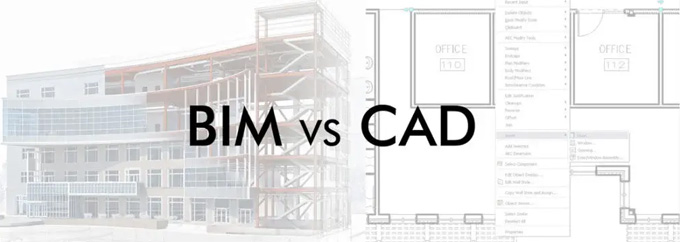
The key advantages of the CAD technology are:
1. CAD technology provides an easy way to communicate with each other about specific parts of a design project.
2. CAD technology helps to create a massive advantage in the design phase and allows the design team members to give feedback in their specific fields.
3. CAD technology helps to visualise the design project ideas at an earlier stage of project realisation, thus providing more perspective and design insight.
4. CAD technology also offers many comprehensive design tools, which help in project visualisation while providing an unprecedented level of customisation.
Building Information Modelling (BIM)
Building Information Modelling (BIM) is the process of collaboration between different parties for designing and building design projects by using unified models in unified databases. BIM technology allows the design departments to analyse and visualise different design choices before beginning the design process.
The key advantages of the BIM technology are:
1. BIM technology has a clash detection feature for multiple materials and design object types, which can interfere with the creation of the design project.
2. The BIM technology has multiple dimensions of the design project in a single working process, which includes time constraints, cost calculation features, thermal and acoustic properties.
3. BIM technology helps to represent the entire design process to create a building as a series of steps, which enables different measurements and considerations to be done as early as possible to prevent the requirement to reconstruct the entire project.
Key differences between BIM and CAD
On the basis of the drafting
BIM technology has the ability to draft both 2D and 3D design models. On the other hand, CAD can also draft 2D and 3D design models, though this drafting process is limited later.
On the basis of the data management capabilities
BIM technology has data management capabilities and includes various project-associated data, for example, scheduling (4D), estimation (5D), facility management (6D), and others. On the other hand, CAD technology has no data management capabilities.
On the basis of the rendering feature
BIM technology has a design rendering feature, whereas CAD technology has a partial rendering feature.
On the basis of the design workflow
BIM technology helps to cover the entire project realisation workflow from the early design process to the post-construction maintenance process. On the other hand, the CAD technology revolves around drafting and rendering design models.
Based on the parametric design feature
BIM technology has a parametric design feature, which is not offered by CAD technology.
Based on the technical differences
The BIM design model has been made to be dynamic from the start, which helps to create opportunities for zooming in, zooming out, and other dynamic actions. This process is difficult to perform with CAD design models. On the other hand, CAD design models help to offer highly detailed representations of structures by using a static viewing angle.
The CAD design models do not have the knowledge of how the design elements have been connected to one another outside of the fundamental static perspective. On the other hand, BIM technology includes the precise design context, which can deal with other design objects instead of geometric design elements.
Concept about CAD to BIM conversion
CAD conversion refers to the process of converting the existing design data, including paper drawings, PDF documents, hand-drawn blueprints, or legacy digital files, into accurate and editable digital formats by using CAD software. This CAD conversion enables the older or incompatible designs to be reused, integrated and modified within modern design workflows and software platforms. The CAD conversion process includes:
To get online demonstration, watch the following video tutorial.
Video Source: The BIM skills
➢ Paper or scanned drawings can also be converted into edible 2D or 3D CAD files.
➢ The translation of the digital drawings from one CAD file format to another file format to achieve better compatibility.
➢ The transformation process of 2D CAD designs into 3D CAD or BIM design models for enhancing visualisation and analysis.
Different CAD formats, for example, DWG, DGN, DXF, and STEP, can be converted by the CAD experts into IFC-compliant BIM deliverables. The experienced team of CAD experts adheres to a streamlined process, which helps to ensure accuracy and interoperability. CAD to BIM conversion services include:
1. Conversion of architectural 2D CAD files to BIM modelling.
2. Conversion of structural CAD files to BIM modelling.
3. Conversion of MEP data.
4. Producing a clash detection-ready BIM model setup.
Gallery
Feel free to contact us for BIM requirements. One of our representative will respond you within 24 Hours. Send us your projects requirement today and grow your project.
Explore More !