

The Panama Canal is considered as the most vital water ways in the globe. It facilitates running of 5% of global trade. The Panama Canal development project is undertaken to increase that volume significantly within 2016.
The Panama Canal contains two lock lanes at both the Atlantic and Pacific entrances to the canal. The Panama Canal Expansion Third Set of Locks project comprises the building of two new sets of locks - one on the Pacific and one on the Atlantic side of the canal.
Each lock will encompass three chambers and each chamber will include three water reutilisation basins. The new locks will be attached with the existent canal system.
MWH Global has been performing for more than 10 years, as it advanced from a concept to a project in progress. MWH presently acts as the principal technical designer in the design together with CICP Consultores Internacionales, LLC, on the Third Set of Locks. This is the biggest fraction of the projected $5.25 billion project.
MWH Global has integrated building information modelling (BIM) into the design delivery to complete the project successfully.
How BIM was applied in the project successfully
BIM facilitates the project team members to go with the most excellent convenient practices on many parts of the project.
Usefulness of BIM for the project:
BIM modeling processes was utilized in diversified methods on this project by the designer team:
Virtual conflict detection reduces field construction modifications which seem to be costly and challenging to project schedules. Two-dimensional construction drawings can be taken out from the BIM model, which is built up involving all these aspects and utilized by the contractor.
MWH Global co-operates with design teams in five offices all over the globe. BIM generates intelligent 3D models which facilitated this multifarious team comprising of engineers to collaborate in an efficient manner as well as allowing them to settle design clashes prior to set up of actual construction. This also aids in synchronizing the project that saved significant time and money.
MWH is designing several elements simultaneously, and BIM aided the team to incorporate modifications instantly and more assertively. With BIM, the contractors and designers got the ability to visualize and supervise the layout of complex electrical and mechanical systems efficiently.
Using Autodesk BIM: MWH applied Autodesk BIM solutions for the following purposes-
Throughout the tender design, MWH modeled various design options with Autodesk 3ds Max Design and created design visualizations which were useful for recognizing these designs and undertaking more informed decisions.
In final design, Autodesk Revit products were applied to generate detailed designs of the canal's new lock and dam structures, site features, and supporting utilities. AutoCAD Civil 3D was also used for creating the site design.
With Intelligent 3D models, the design team got a brief overview of the large and complicated designs. They were helpful in coordinating design and documentation, saving both time and money. The team consolidated the design models to enhance the cross-discipline coordination and get rid of design clashes prior to actual construction begins.
With progression of the design-build project regarding the Third Set of Locks of the Panama Canal Expansion project, the design team had developed many design elements in parallel. BIM offered the system to combine essential design modifications to keep the project going successfully.
Conclusion: BIM can also be a crucial tool after surrender of project to the owner. The owners can get help through a powerful operations and maintenance tool to address the facility's long-term requirements. BIM will become the vital resource for asset formation and asset management. It will allow the facility to be well-organized, and also demonstrate how resources utilized to address significant infrastructure needs all over the world to be utilized in an efficient manner.
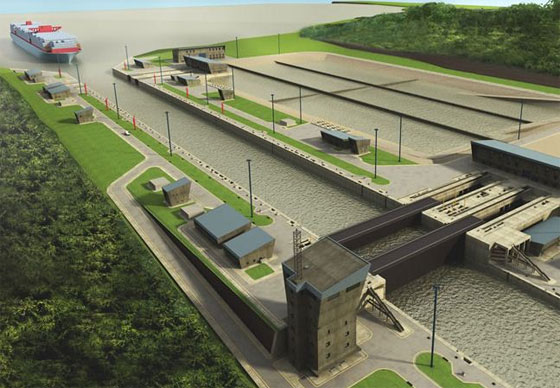
Image Courtesy: dredgingtoday.co
We're here to help if you don't know where to look for information about BIM.

21/1 Canal Street, Laketown, VIP crossing
Kolkata, West Bengal - 700 048
E mail : enquiry@bimoutsourcing.com
Phone: (+1) 713 429 1909
All right reserved. All site content copyright.
Site Design and Developed by Global Associates